“Your loan application has been declined.”
This notification pops up on your phone, offering no explanation, no one to speak to, and no clear indication of the factors that influenced the decision or whether it was even justified.
Unfortunately, this is becoming a common experience for many Nigerians.
This issue has been prevalent even before the advent of artificial intelligence (AI), but AI is increasingly affecting decisions that impact our daily lives. These include our eligibility for loans, the content we view online, the prices we are offered, and even the customer service we receive. While AI has the potential to improve these situations, many of us are unaware of its influence, which could be the most significant problem.
When discussing AI, the conversation often centers around innovation, investment, or the future of work. While these discussions are important, there is another crucial question that deserves attention:
What happens to consumers when AI makes decisions that affect them?
Nigeria’s digital financial services have expanded access to millions who were previously excluded from formal financial systems, according to a 2026 study in the Journal of Risk and Financial Management. Many of these services are now faster, more efficient, and more scalable with the help of artificial intelligence.
That progress is worth celebrating.
However, efficiency alone is not enough. Trust is also important.
Consumer protection has always been about ensuring that markets function fairly by empowering consumers, holding businesses accountable, and strengthening effective monitoring. As artificial intelligence becomes more embedded in our daily lives, these principles are more significant than ever.
Technology should never reduce a consumer’s ability to understand, question, or challenge decisions that affect them.
Imagine being denied access to loans because of an automated evaluation. Imagine receiving different prices for the same product because of an algorithm you knew nothing about. Imagine being inaccurately profiled by data that you cannot access or correct.
These issues go beyond just technology. They are consumer protection issues.
Innovation without accountability creates new risks
Some argue that stronger regulation could slow innovation. I see it differently.
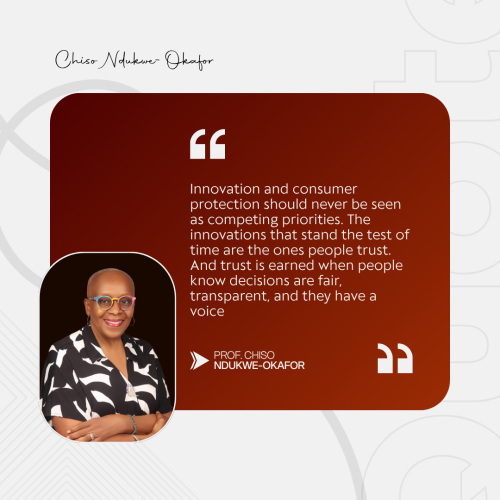
Innovation and consumer protection are not mutually exclusive. In fact, the most sustainable innovation is the kind people trust. Consumers are more likely to adopt new technologies when they trust that the systems are transparent, accountable, and fair.
Transparency increases confidence. Accountability fosters trust. For innovation to thrive, both are required.
As Nigeria continues to advance its digital economy, we should be asking questions that place consumers at the center of the technological progress:
- Are our consumer protection frameworks evolving as quickly as the technologies they seek to govern?
- Should consumers be able to request an explanation for significant automated decisions?
- What happens when an algorithm gets it wrong?
- How do we reduce the risk of bias and discrimination in AI systems?
These questions are not anti-innovation. They are pro-consumers, and ultimately, they are pro-trust.
The future of AI should include consumers
Financial services, commerce, healthcare, and public services will all continue to be transformed by artificial intelligence. The question is no longer whether AI should shape our future, but whether consumers will have a significant say in how it does.
Technology built without consumers in mind risks creating systems that are efficient but not equitable, while consumer-focused technology has the potential to improve lives, increase opportunities, and build trust.
That, in my view, is the future worth building.