
 Community Support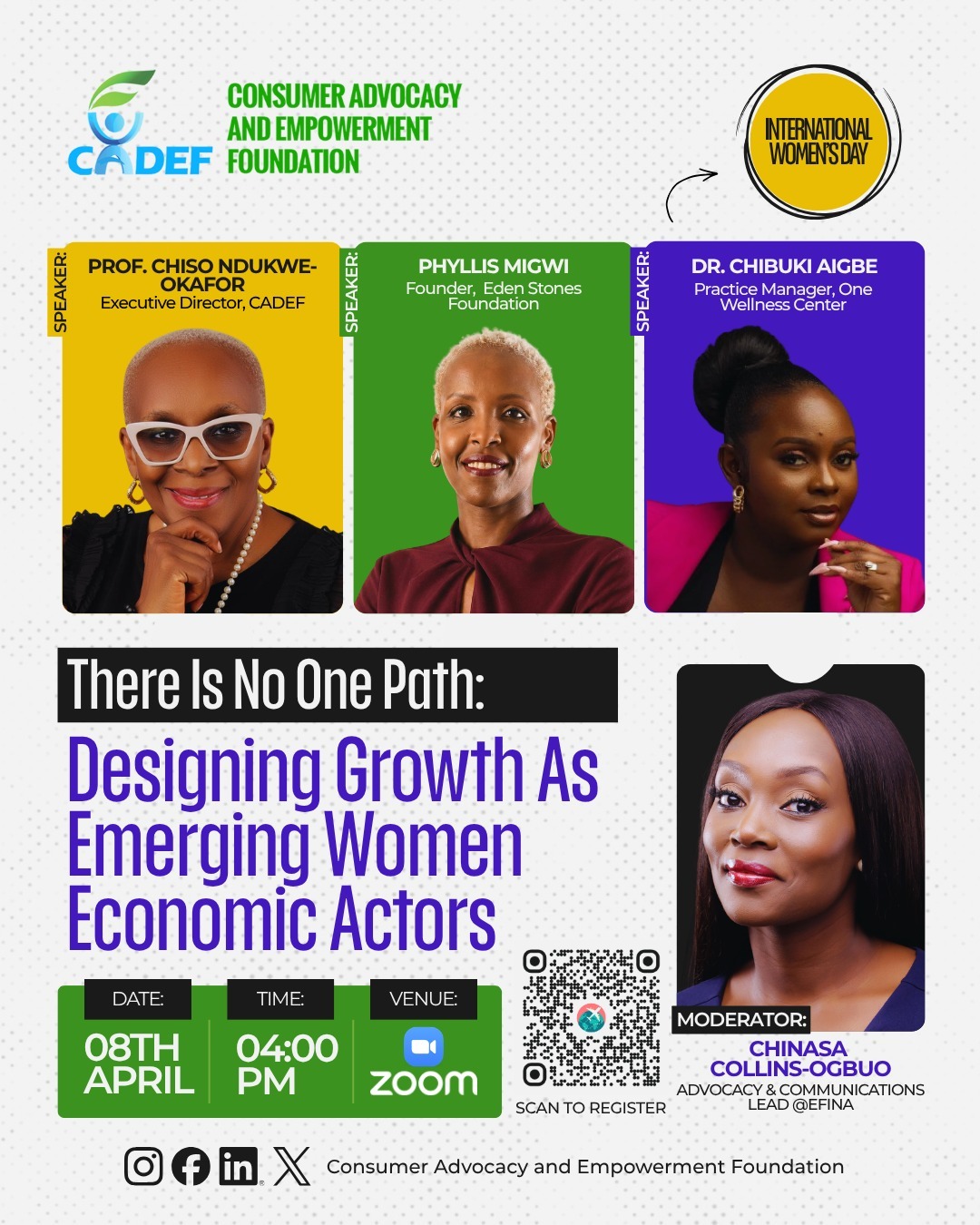
Across Nigeria today, more women are working, launching businesses, and participating in the economy than ever before. Yet many are doing so without the frameworks, the clarity, or the structures needed to grow sustainably and intentionally.
It was against this backdrop that Consumer Advocacy and Empowerment Foundation organized a virtual panel session, bringing together a cross-section of professionals, entrepreneurs, and economic thought leaders for an honest and practical conversation about what women's growth actually looks like.
Hosted in commemoration of International Women's Day 2026, the virtual panel session; There Is No One Path: Designing Growth as Emerging Women Economic Actors, examined what it truly takes for women to move from simply participating in the economy to actively and intentionally shaping it.
The session was moderated by Chinasa Collins-Ogbuo, Advocacy Lead at Enhancing Financial Innovation and Access (EFInA), who guided the conversation with clarity and depth, creating space for honesty over performance.
Bringing a career development perspective, Phyllis Migwi spoke to the importance of intentional progression, challenging the assumption that professional growth happens by default. She emphasised that building a career with long-term relevance requires deliberate decisions, continuous learning, and the courage to remain open to redirection, even when the path ahead is unclear.
From an enterprise-building standpoint, Dr. Chibuki Aigbe drew a sharp distinction between making income and building something that lasts. She highlighted the operational and strategic thinking required to move beyond activity toward architecture, offering practical insight into what it means to grow a business with structure, purpose, and sustainability at its core.
Connecting individual journeys to the wider economic landscape, CADEF's Executive Director, Prof. Chiso Ndukwe-Okafor, situated women's economic participation within the broader systems, markets, and institutions that shape what is possible. She emphasised that the choices women make in their careers and businesses do not exist in isolation but ripple outward, influencing communities, markets, and long-term outcomes.
A factor that shaped the framing of the session was a recurring reality among Nigerian women navigating professional and economic life. Many enter their careers or businesses with the belief that growth follows a straight and predictable line, only to find that delays, pivots, and uncertainties are not exceptions but features of the journey.
The conversation challenged this narrative directly. Panellists were candid about the misconceptions they carried early in their own journeys, the belief that formal education marked the end of learning, that clarity comes before action, and that success on someone else's timeline was the only valid kind. These were not presented as cautionary tales but as reframes, practical shifts in thinking that participants could apply to their own situations.
The session echoed a shared responsibility in women's economic growth. Systems must create more equitable access to opportunity, institutions must design with women's realities in mind, and women themselves must move from participation to intention, from working hard to building with direction.